
Footwear Craft • Guide
What Are Goodyear Welt Shoes? A Complete Guide for Modern Gentlemen
By Imam Karakus • Founder, Shoescoo
Goodyear welt shoes are the gold standard of classic shoemaking — built to be repaired, not replaced. In this guide, we explain how the construction works, why it outlasts glue and single-stitch methods, and how to choose a pair you’ll wear for years.

What Exactly Is a Goodyear Welt?
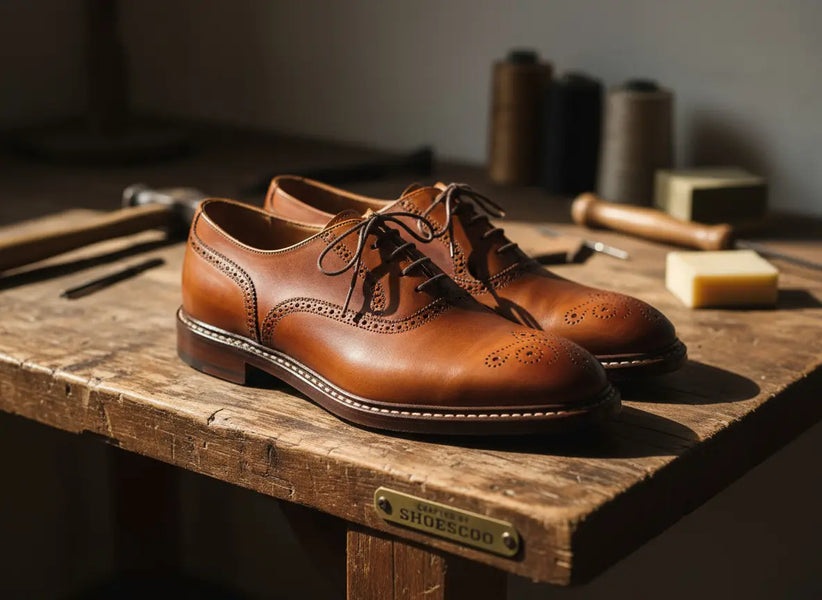
A welt is a narrow strip of leather stitched around the perimeter of the shoe, joining the upper to the insole. The outsole is then stitched to this welt, not directly to the upper. That separation creates a durable, water‑resistant structure and makes resoling clean and repeatable.
The method dates to the late 1800s and Charles Goodyear Jr.’s innovation. Today it remains the benchmark for dress oxfords, derbies, and robust men’s boots.
Why Goodyear Welted Shoes Last Longer
- Resoleable by design: The outsole is stitched to the welt, so a cobbler can replace it without disturbing the upper.
- Comfort that improves: A cork layer under the insole compresses and molds to your footprint after a few wears.
- Weather resistance: The welt channel and stitching help keep moisture out while letting leather breathe.
- Total cost of ownership: One well‑made pair outlasts multiple cheaper glued shoes.
From my own wear-testing, the cork mid-layer softens within the first week—that’s when the shoes start to feel custom to your feet.
| Feature | Goodyear Welt | Blake Stitch | Cemented (Glued) |
|---|---|---|---|
| Durability | ★★★★★ | ★★★☆☆ | ★☆☆☆☆ |
| Resoleable | Yes (multiple times) | Limited | No |
| Water Resistance | Good | Fair | Poor |
| Break‑in Comfort | Molds to foot (cork mid‑layer) | Flat feel | Rigid |
| Longevity | 10–20 years with care | 3–5 years | 1–2 years |
How Goodyear Welt Construction Works (Step‑by‑Step)
- Lasting: The leather upper is pulled over a last (foot form) and secured to the insole.
- Welting: A leather welt is stitched through the rib of the insole and the upper.
- Cork Filling: A comfort layer fills the cavity, which will compress to your footprint.
- Sole Stitch: The outsole is stitched to the welt (not the upper), creating a serviceable edge.
- Finishing: Edges are trimmed and burnished; the shoe is polished and inspected.
How to Care for Goodyear Welted Shoes
- Insert cedar shoe trees after every wear to absorb moisture and maintain shape.
- Brush dirt off, then condition leather monthly to prevent drying and cracking.
- Rotate pairs; avoid wearing the same shoes two days in a row.
- Resole when the tread thins — the upper will keep going for years.
Frequently Asked Questions
Are Goodyear welt shoes worth it?
Yes — you pay for serviceability, comfort, and longevity. Over a 5–10 year window they’re typically cheaper than replacing glued shoes every season.
Goodyear welt vs. Blake stitch — which is better?
For durability and weather resistance, Goodyear welt wins. Blake can feel lighter and more flexible but is less protective and often harder to resole.
How long do Goodyear welt shoes last?
With routine care and occasional resoles, a quality pair can last 10–20 years. The leather upper is built to outlive multiple outsoles.
Do they need a long break‑in?
They soften quickly. The cork mid‑layer molds to your foot within a few wears, improving comfort over time.
About the Author
I'm Imam Karakus. I work directly with our workshop to oversee leather selection and Goodyear welt construction details. My goal is simple: footwear you can repair—not replace.